Philippine STP Technology Update:
Advanced Biological Treatment Gains Ground
Wastewater treatment technology in the Philippines is evolving.
From AAO biological treatment and packaged MBR systems to MBBR and newer aerobic granular sludge processes, recent projects show a growing emphasis on compact treatment, nutrient removal, automation, compliance and water reclamation.
For developers and facility owners, the change is important: selecting an STP is increasingly about more than simply achieving BOD and TSS removal.
Modern systems must consider space, energy, nutrient removal, operator requirements, reliability and the possibility of treated-water reuse.
Philippines Introduces Aerobic Granular Sludge Technology
One of the country’s notable recent developments is Manila Water’s adoption of NEREDA® aerobic granular sludge technology for its UP Sewerage System Network Project.
Announced in February 2026, the approximately ₱220-million facility in UP Diliman is identified by Manila Water as the first NEREDA sewage treatment plant in the Philippines. The project is designed as a 5-million-liter-per-day STP.
Unlike conventional activated sludge, the technology develops microorganisms into compact biological granules.
Within the granules, different biological conditions can coexist, allowing processes such as organic removal, nitrification, denitrification and biological phosphorus removal to occur.
This is an important local development because it demonstrates that Philippine wastewater projects are beginning to adopt additional biological-treatment alternatives alongside more established technologies.
AAO Technology Moves Forward in Metro Manila
Another major wastewater project demonstrates the continuing relevance of Anaerobic-Anoxic-Oxic or A2O/AAO technology.
Maynilad’s Las Piñas Water Reclamation Facility was designed for a treatment capacity of up to 88 million liters per day, serving an estimated 360,000 residents across 20 barangays.
Maynilad identified A2O technology for the facility to provide biological pollutant removal and meet applicable effluent requirements.
The process illustrates the increasing importance of designing biological treatment not only around organic pollution but also around nutrient management.
Why AAO Matters
A typical AAO process separates treatment into three biological environments:
ANAEROBIC
Supports biological processes associated with phosphorus management.
ANOXIC
Provides conditions for denitrification and nitrogen removal.
OXIC / AEROBIC
Provides aeration for organic removal and nitrification.
Correct design requires careful consideration of internal recycle rates, dissolved oxygen, sludge age, organic loading and wastewater characteristics.
Packaged MBR Systems Expand Decentralized Treatment Options
Smaller developments also need advanced wastewater solutions.
Manila Water Infratech Solutions has introduced a packaged sewage treatment system incorporating Membrane Bioreactor technology. In a 2025 project update, the company described a compact iTECH Packaged STP with a treatment capacity of 10 cubic meters per day for smaller wastewater applications.
This demonstrates an important trend for the Philippine market:
Advanced wastewater technology is no longer limited to large municipal plants.
Packaged systems can make technologies such as MBR more accessible for:
- Restaurants
- Commercial establishments
- Resorts
- Small hotels
- Offices
- Institutional facilities
- Remote developments
- Industrial facilities
Where Does MBBR Fit?
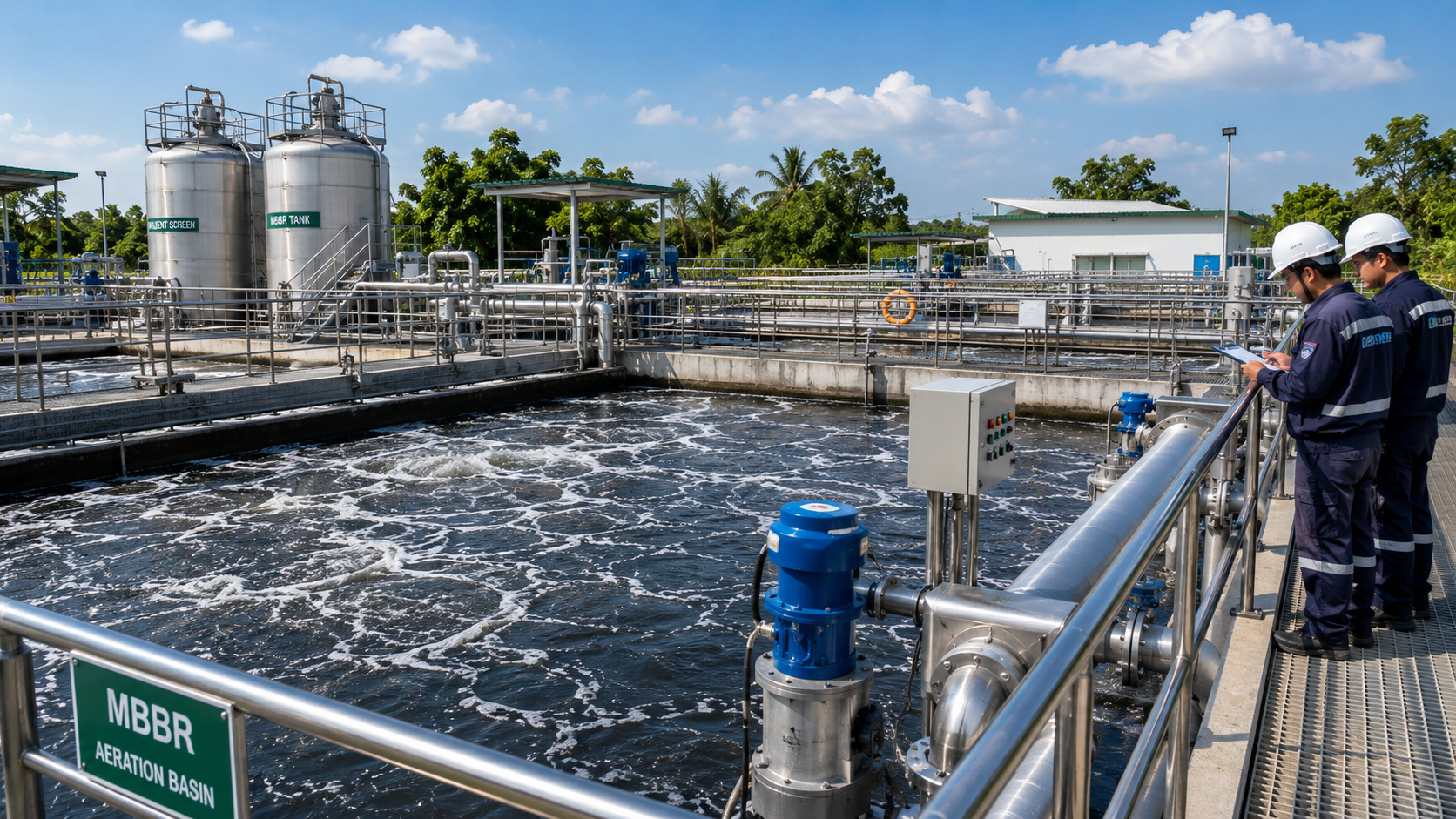
Moving Bed Biofilm Reactor technology remains highly relevant to decentralized and modular STP applications.
Instead of maintaining all biological microorganisms as suspended sludge, MBBR allows microorganisms to develop as biofilm on specialized carrier media.
For Philippine applications, MBBR can be particularly attractive when projects require:
- Compact biological treatment
- Modular construction
- Resistance to changing wastewater loads
- Simple expansion
- Retrofit of existing biological tanks
- Straightforward operation
International experience also continues to demonstrate that MBBR can be used to increase the treatment capacity of existing facilities without necessarily constructing entirely new biological basins.
SBR Remains Part of the Philippine Technology Mix
Sequencing Batch Reactor technology also remains present in the country’s wastewater infrastructure.
Maynilad’s published facility information identifies SBR technology in facilities including the Manila North Water Reclamation Facility, demonstrating that batch biological treatment remains part of the range of technologies used in Philippine wastewater applications.
For smaller private STPs, SBR can also offer a practical configuration where adequate equalization, automation and operating controls are provided.
The Next Upgrade: Equipment and Automation
Treatment technology alone does not determine whether an STP performs well.
The supporting equipment is equally important.
Modern STP Equipment
Blowers
Provide oxygen for aerobic microorganisms.
Fine-Bubble Diffusers
Improve oxygen transfer into biological reactors.
Submersible Pumps
Transfer wastewater and sludge between treatment stages.
Mixers
Maintain proper conditions in equalization and anoxic tanks.
Chemical Dosing Systems
Provide controlled addition of disinfectants, coagulants, pH chemicals or supplementary carbon sources where required.
Sludge Dewatering Equipment
Filter presses, screw presses and other systems reduce sludge volume.
Instrumentation
DO, pH, ORP, level, flow and other sensors provide information about actual plant conditions.
From Automation to Smart STP Operation
Philippine STPs are also moving toward greater use of:
PLC Control • VFDs • SCADA • Remote Monitoring • Online Sensors • Alarm Systems • Automated Dosing
This can allow an STP to respond more intelligently to changing wastewater conditions instead of operating every pump and blower continuously at maximum capacity.
Maynilad’s current procurement program, for example, separately identifies automation and instrumentation works as part of its infrastructure requirements and also lists upgrades of wastewater facilities to address current effluent standards.
What Technology Should a Philippine Project Use?
The answer should not begin with MBBR, MBR, SBR or AAO.
It should begin with the wastewater.
MBBR
A strong option where compact biofilm treatment, load flexibility and modularity are priorities.
MBR
Attractive where space is limited and high-quality effluent or reuse is an important objective.
SBR
Useful where controlled batch biological treatment provides a practical operating configuration.
AAO
Especially relevant when biological nitrogen and phosphorus removal are important.
Aerobic Granular Sludge
An emerging Philippine option illustrated by the country’s first NEREDA project.
Technology Must Follow the Project
A successful STP starts with understanding:
Flow → Wastewater Characteristics → Effluent Requirement → Site Conditions → Treatment Process → Equipment → Controls → Operation
Choosing a treatment technology simply because it is the newest or most expensive does not automatically create the best STP.
The goal is to select the right process for the actual wastewater and project conditions.
CebuSTP Perspective
For Cebu and other rapidly developing areas of the Philippines, the increasing availability of MBBR, MBR, SBR, AAO, modular STPs, advanced filtration and smarter controls gives developers more options than ever before.
The opportunity is to combine proven treatment principles with technologies that make STPs more compact, reliable, maintainable and ready for the country’s evolving wastewater requirements.
CebuSTP.com
Design • Build • Fabricate • Supply • Install • Operate • Maintain
continue reading
Related Posts
Vestibulum ante ipsum primis in faucibus orci luctus et ultrices posuere.