Global STP Technology Update:
Compact, Smarter and More Efficient Treatment Takes Center Stage
The wastewater treatment industry is continuing its shift toward higher treatment capacity, smaller footprints, improved nutrient removal, water reuse and smarter operation.
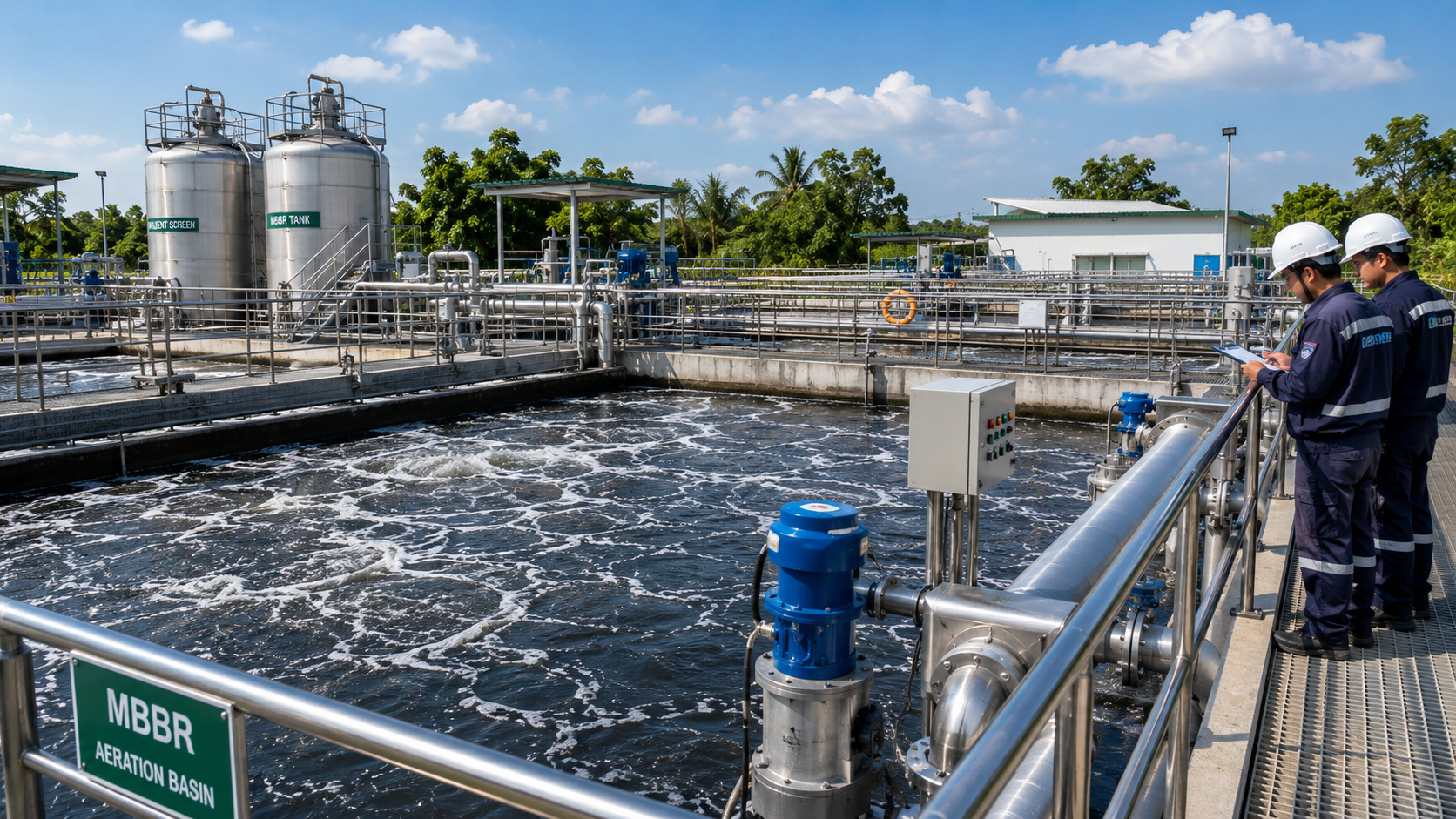
One of the clearest examples in 2026 is happening at the Käppala wastewater treatment plant in Sweden, where a major upgrade is introducing Moving Bed Biofilm Reactor or MBBR technology into some of the plant’s biological treatment basins.
In May 2026, the utility reported a major project milestone as its first converted MBBR basin began being filled with biofilm carriers. The basin holds about 16.5 million liters when operating, and approximately 2 billion carriers are required for the basin. The upgrade is intended to increase treatment capacity and improve nitrogen removal while making use of existing treatment infrastructure.
MBBR: More Treatment Within Existing Space
MBBR technology provides microorganisms with specially designed carrier media on which biological films can grow.
The significance of projects such as Käppala is not simply the use of MBBR itself. It demonstrates how existing wastewater plants can potentially increase biological treatment capacity without constructing completely new reactor structures.
Käppala is converting existing basins and adding new zones, screens, aeration systems and mixers. Its upgraded treatment processes are being prepared for stricter future limits for nitrogen, phosphorus and organic material.
For developing cities where available land is becoming increasingly limited, this type of retrofit approach is particularly relevant.
MBR: Treatment and Filtration Continue to Converge
Membrane Bioreactor or MBR technology continues to play an important role where compact treatment and high-quality treated water are priorities.
Singapore’s national water agency, PUB, describes MBR as a three-in-one process combining the biological reactor, secondary solids separation and microfiltration or ultrafiltration into one treatment stage. PUB continues to use MBR as part of its approach to water reclamation.
For industrial applications, PUB also identifies MBR followed by reverse osmosis as one option for converting treated industrial effluent into reusable process water.
This points toward an important direction for STP design:
Treatment is increasingly being designed with reuse in mind—not only discharge.
SBR: Flexible Batch Treatment Remains Relevant
Sequencing Batch Reactor or SBR remains an established option for sewage treatment, particularly where designers want biological treatment, settling and decanting to occur in a controlled sequence.
The technology itself is mature, but improvements in:
- PLC control
- Dissolved oxygen monitoring
- Variable-frequency drives
- Automated valves
- Level instrumentation
- Online water-quality sensors
are making modern SBR systems easier to control and optimize.
Instead of viewing SBR simply as a tank operating on a timer, modern plants can increasingly operate according to actual process conditions.
AAO: Nutrient Removal Becomes More Important
Anaerobic-Anoxic-Oxic or AAO/A2O treatment remains particularly important where nitrogen and phosphorus management is part of the treatment objective.
The process separates biological conditions into different zones so that organisms can perform different treatment functions.
This principle is also visible in newer biological-treatment innovations. For example, aerobic granular sludge technologies can create aerobic, anoxic and anaerobic micro-environments within biological granules, allowing several biological processes to occur within one treatment system.
The Bigger Innovation Is Integration
The future of STP technology may not be about finding one process that replaces everything else.
Instead, treatment plants are increasingly combining technologies.
Biological Treatment
MBBR • MBR • SBR • AAO • Aerobic Granular Sludge
Separation
Clarifiers • Membranes • Disc Filters • Sand Filters
Aeration
Fine Bubble Diffusers • High-Efficiency Blowers • Automated DO Control
Disinfection
UV • Chlorination • Ozone
Sludge Treatment
Thickening • Filter Press • Screw Press • Dewatering
Automation
PLC • SCADA • Remote Monitoring • Online Sensors • Data Analytics
Equipment Is Becoming Smarter Too
Improving the biological process is only one part of modern wastewater treatment.
Pumps, blowers, mixers, diffusers, dosing equipment and instrumentation can account for a significant part of how reliably and efficiently an STP operates.
The emerging design philosophy is therefore moving from:
“Install equipment and operate it.”
toward:
“Measure the process, understand the demand and operate equipment only as much as necessary.”
Variable-frequency blowers, automatic dissolved-oxygen control, smart pumping, online monitoring and predictive maintenance will increasingly become part of modern STP design.
What This Means for Future STP Projects
There is no universally “best” wastewater technology.
A 100 CMD hotel STP, a 1,000 CMD residential development and a 100 MLD municipal wastewater facility have very different requirements.
Technology selection should consider:
Wastewater Flow
Average and peak hydraulic loading.
Organic Loading
BOD, COD, TSS and other wastewater characteristics.
Nutrient Requirements
Nitrogen and phosphorus discharge limits.
Available Space
Land and structural constraints.
Water Reuse
Whether treated water will simply be discharged or reused.
Energy Consumption
Particularly aeration and pumping requirements.
Operation & Maintenance
Availability and skill level of operators.
Lifecycle Cost
Not simply the initial construction price.
The Direction Is Clear
From large MBBR retrofits in Europe to membrane-based water reclamation systems in Asia, wastewater treatment is increasingly moving toward compact, efficient, automated and reuse-ready systems.
MBBR, MBR, SBR and AAO will continue to have their respective places in wastewater engineering.
The innovation is increasingly in how these processes are designed, integrated, monitored and optimized for each application.
CebuSTP Technology Watch
At CebuSTP.com, we continue to follow developments in biological treatment, filtration, aeration, sludge handling, automation and water reuse to identify technologies that can be practically applied to wastewater projects in the Philippines.
continue reading
Related Posts
Curabitur non nulla sit amet nisl tempus convallis quis ac lectus mauris.